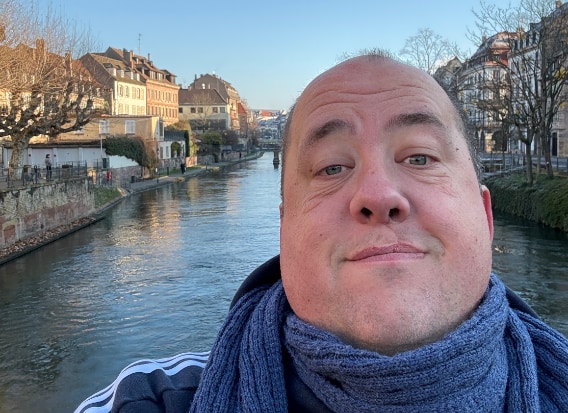
Have you seen ads on LinkedIn and elsewhere for AI-powered professional headshot generation? I’ve seen a lot of them, and a few days ago I tried one.
The user experience was solid. Upload 10 photos of yourself, choose various styles (“blazer in open office,” “hoodie on tree-lined street,” etc), let it crunch for 15 minutes, and then get your watermarked headshots and decide if you want to pay for them or not. The generated images were impressive—they took 15 pounds off me and made my clothes fit like they were perfectly tailored (few living souls have ever seen me wear a blazer).
But something was off. As a pulp detective novel might say, they were good… too good.
You see, I was born with a unilateral cleft lip and palate. I had my first repair surgery at six months, and about half a dozen surgeries before graduating high school. My parents had a hell of a time feeding me because I couldn’t suck (with a hole in your palate you can’t produce a vacuum in your mouth) and it was really easy for me to aspirate formula. I missed so many recesses in elementary school doing supplemental speech therapy because the layout and function of my oral cavity kept changing from surgery to surgery, so I had to keep relearning how to pronounce certain sounds. I was in braces for nearly a decade, and still wear a retainer to keep the work they did from being undone. I have a visible scar from my left nostril to the bottom of my lip showing exactly where the cleft was. My nose isn’t quite symmetrical, and my teeth and jaw are still, for want of a better term, a little jacked up.
I don’t recount all of that for sympathy, but rather because being born with a birth defect and working through the complications was a big part of my formative years. It’s part of who I am. I’d like to think that it’s made me both tougher and more compassionate.
But that part of me was totally erased by the AI. I had a straight nose and an even lip. In the photos where I was smiling, my smile didn’t slant off to one side because my jaw isn’t quite straight. It was creepy, like looking at your doppelgänger and realizing it isn’t just a reflection, it’s a different person.
I understand on a technical level why the images are the way they are. Most people aren’t born with cleft lips. Most people don’t have surgical scars on their face. Most people have reasonably symmetrical noses. The image generation model doesn’t know anything about that anyway; it’s just trying to generate an image that fits its training data.
The experience made me think about other places where AI’s pull toward the median falls short. Most code really is repetitive, and an AI can write it just fine. But every so often you encounter a piece of code that is genuinely sublime in a way that makes you stop and reread it. That kind of code doesn’t come from pattern-matching against the training data. It comes from someone who understood the problem deeply enough to find the simple solution on the other side of complexity. AI doesn’t generate beautiful code for the same reason it couldn’t get my face right: the exceptional isn’t what it’s optimizing for.
I didn’t buy the headshots. They were great photos of a different person. I think it’s worth remembering that it’s our scars that make us special.